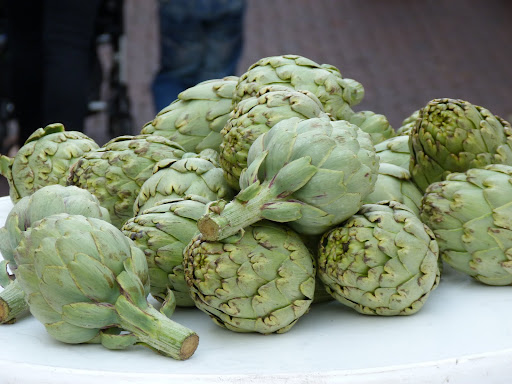
Everyone knows my love for inverted flowers (figs) now time for edible flower buds- artichokes.
These vegetables, or should we call them 'immature thistles' can seem quite intimidating- how one cooks and eats an artichoke is not at all obvious from its appearance. The truth is, they are actually quite easy, if rather time consuming, to prepare.
I tasted my first artichoke as a teenager, and I have been eating them sporadically ever since, getting my 'fix' whenever I feel the urge. During visits to Italy I eat them as often as possible, even be it as Pizza topping.
Due to its unusual appearance, an artichoke has certain wow factor. I served them to my children a few years ago when my husband was at work knowing he would not appreciate artichoke. They were very interested and amused by the content of their plates.
Of course preparing an artichoke is a little more time consuming than throwing a bunch of vegetables together in a stir-fry. Look at it as a labour of love. Underneath it's thorny exterior is a delicious soft and delicious centre- it’s heart. It has a delicate taste difficult to describe, a mix of avocado, asparagus and pea...?
A couple of weeks ago a friend gave me four artichokes. She asked me to cook them and write a post.
The best way to eat an artichoke is of course the simplest method. Cook it whole and peel away its petals one by one (dip them in melted butter, mayonnaise, hollandaise or vinaigrette) and scrape the leaves against your lower teeth until you reach your reward- its heart.
Artichokes can be roasted or grilled, though they tend to be less tender and moist. Alternatively, they can be stuffed and steamed. (Or finish off in the oven)
Preparation:
Artichokes discolour rapidly, if you're going to keep them for any length of time before cooking, soak in water with a couple of lemon slices.
You can remove the hairy choke before or after cooking, I prefer afterwards.
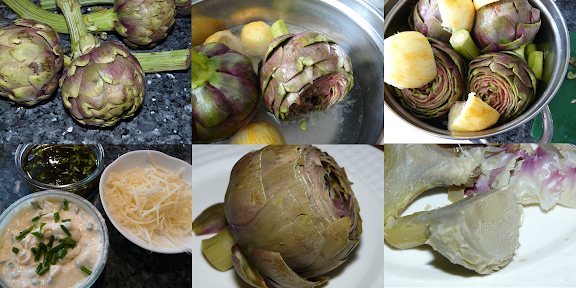
1. Soak the artichokes to clean thoroughly.
2. Slice about 2cm of the top off with a sharp knife.
3. Take a pair of scissors and remove the spiky ends.
4. Remove the inedible, smaller leaves off the base.
5. Leave a short stem on the artichoke. You can peel the remainder stem and cook it along with the artichokes. It is however more fibrous, some people discard it, but I do not like waste.
6. Rinse the artichokes and sprinkle or rub with lemon juice. (I used fresh lemon and placed this on top of the artichokes)
Basic cooking:
Place in a large saucepan stalk side down, with several cm of water, (add a little salt and sugar) and boil for 25 - 45 minutes depending on the size. (Mine were done in 30min)
Artichokes are ready when you can easily pull out a leaf.
Turn the artichokes and drain to remove any extra water and serve warm.
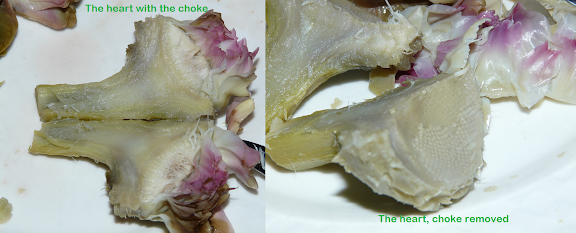
Pull off the outer petals one at a time and dip them in your sauce of choice. Turn the petal dip side down in your mouth and remove the flesh by scraping along your lower teeth. Discard the petal. Continue until all petals are removed. You are now left with a hairy 'choke' and the heart. The choke should be removed by cutting and scraping away. Cut the heart in pieces and continue dipping.
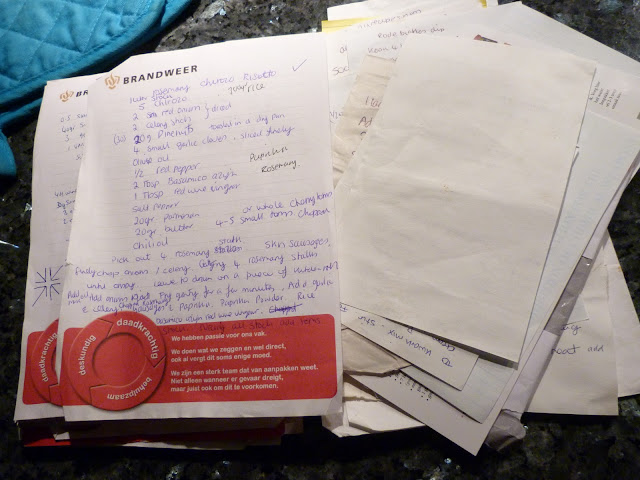
I rifled through my cookery books and found a classic artichoke recipe with a selection of dipping sauces. It was from the book Topkoks voor Thuiskoks 2. It is part of a serie of four books discussed here
I omitted the mashed potatoes.
The recipe is rather vague with no measurements, so it is up to you find what suits you taste. I was rather intrigued by the east meets west combination of balsamic vinegar and sambal.
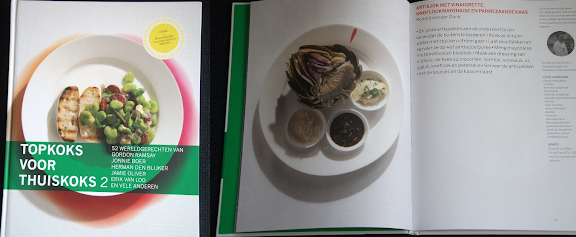
Artichokes with vinaigrette, garlic mayonnaise and parmesan cheese- Ronald van der Donk
to serve four:
4 large artichokes
1 lemon
garlic, crushed
mayonnaise
chives, finely sliced
grated parmesan cheese
olive oil
balsamic vinegar
red wine vinegar
sambal
soy sauce
chopped onion
chopped shallot
chopped red onion
garlic, crushed
parsley, chopped
mashed potato
Cut the artichokes at the base and remove the outside leaves. Cook them in water with the lemon pieces until tender. (I removed the zest and used it in my main course)
Allow them to drain and serve them with mashed potato.
Mix the mayonnaise with the garlic and chives.
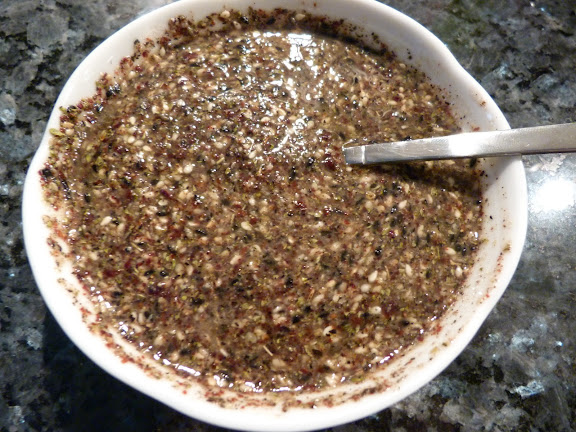
Make a dressing with the olive oil,the two types of vinegar, sambal, soy sauce, onion, shallot, garlic, and parsley.
Serve the artichokes with the dips and cheese.
Wine suggestions:
Viognier Lés Gres,
Vin de Pays d'Oc, 2006,
mild and ripe with white fruit,
delicate
I served as main course a Mediterranean mix of sausages, vegetables and couscous, adding the artichoke stalks at the end. As we were eating our appetiser, the couscous was soaking.
Hubby looked rather bemused- he was this time of the party. He stated that he had more on his plate than when he had started! It certainly works well as an appetiser- he was ready for the main course! He cannot understand why one would go to so much trouble when they are available in jars!
Artichokes are native to the Mediterranean region. My artichokes came from Italy- a friend is able to order them. They are quite a nutritional powerhouse, http://nutrition.about.com/od/fruitsandvegetables/p/artichokes.htm so as long as you do not overdo the fat level in the dips they should be healthy too!
Unusual facts:
Artichoke lover: Marilyn Monroe, Norma Jean at the time, was crowned Castroville's (California, USA) first Artichoke Queen in 1947. The city itself is known as the "Artichoke Center of the World"
Wine killers: Artichoke has the peculiar property of altering the taste buds in most people .This natural chemical change causes food and drink consumed after artichokes to taste sweeter- ruining the true flavour of your chosen wine! This can be easily be taken into consideration by selecting an acidic wine. This is only true of fresh artichoke and it does not apply to the jars.
Artichokes were in abundance at the Leiden market two weeks ago. It was a beautiful day, the first real warm sunshine in Holland this year. The miss match of winter coats and short skirts were a result of this period of transition. The terraces were filling, the market traders were busy and smiling, love was certainly in the air and on the canal you could even spot the odd boat passing by.
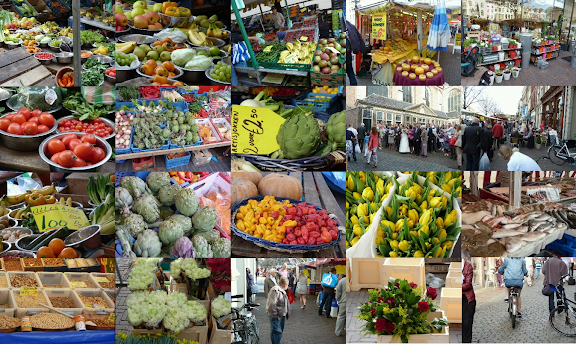
BTW It was me wearing the winter coat ;-) and very much regretting it!
Ending on a rather thoughtful note- what was that first person thinking who decided to eat this thorny creature? And how sad that artichokes are never allowed to reach their full potential...life is strange.